







Skip to content
Swiss chalet with a photovoltaic system at sunrise

COMPLETE PV SYSTEMS · OPTIONAL STORAGE

Solar panels Graubünden: cost, incentives and installation

A 5–10 kWp rooftop system costs around CHF 14,500–23,300 before incentives in the Swiss market comparison. Pronovo pays a one-time CHF 360 per kW for a typical home system, and the canton adds CHF 150 or 300 per kWp if conditions are met. Roof systems usually need only a notification to the municipality.

Cantonal grant only if you apply on energie.gr.ch before construction

View services
Built to Swiss standards (NIN/ESTI)Free & non-bindingData stays confidential

Solar in Graubünden

Four checks before your quote.

Roof, municipality, grid and funding: the key decisions at a glance.

Explore details & sources
  1. Funding

    CHF 150 per kWp for large systems on homes or CHF 300 for steep winter-power systems.

  2. Municipality & permits

    Submit one form per building at least 15 days before installation.

  3. Grid & tariff

    Identify the grid operator, file the connection early and model exports separately.

  4. Costs & quote

    Ask for itemised positions and a month-by-month yield estimate.

Explore as needed

Planning details & sources.

01Funding

Which cantonal grant fits your roof

Graubünden funds photovoltaics through two programmes that cannot be combined. Residential buildings receive CHF 150 per kWp if the system exceeds the reference demand of 20 watts per m² of energy reference area by at least 50 percent and by at least 3 kWp; the capacity above 30 watts per m² is funded. Example: with 200 m² of energy reference area, a system qualifies from 7 kWp, and at 10 kWp, 4 kWp are funded, i.e. CHF 600. Steep winter-power systems with a 60 to 90 degree tilt receive CHF 300 per kWp. Both programmes require global radiation above 1,250 kWh per m² and year on the cantonal potential map and an application on energie.gr.ch before any construction or order. Together with Pronovo, public contributions may cover at most 50 percent of the costs.

02Municipality & permits

A notification to the municipality instead of a building application

In Graubünden, roof-mounted solar systems are subject to notification, not the building application procedure (Art. 40b KRVO). The cantonal form is completed per building and submitted to the municipal building authority at least 15 days before installation. The municipality checks under federal law whether the system is sufficiently adapted and has 15 working days to state that a building permit is required after all; if it does not respond within that period, work may begin. For protected buildings, townscape protection zones and larger facade systems, clarify the procedure before awarding the contract.

03Grid & tariff

Grid operator first: connection and tariff depend on the location

More than 40 grid operators work in Graubünden, from Repower to IBC in Chur, EWD in Davos and small municipal utilities. The grid operator at your address determines the connection, metering concept and the value of a self-consumed kWh. The electrician files the technical connection request early, in parallel with the notification. Exported power is paid at the SFOE quarterly reference market price, with at least 6 ct/kWh for systems up to 30 kWp; in 2026 Repower adds 0.5 ct/kWh for guarantees of origin in the first and fourth quarters and 0.2 ct/kWh in the second and third.

04Costs & quote

Make quotes comparable before you sign

For rooftop systems of 2 to 10 kW, the Swiss median in 2025 was CHF 2,497 per kW excluding VAT, and CHF 1,911 per kW for 10 to 30 kW. Roof renovation, structural reinforcement, a new meter cabinet and a battery come on top. Ask for separate items for mounting, electrical work, grid connection and battery, and for a monthly yield estimate: the winter share differs considerably between municipalities in Graubünden, and a steep design for the winter-power grant is a separate calculation, not an obligation.

For the initial roof check

What to have ready.

  • Record the energy reference area, roof tilt and orientation to identify the right funding programme.
  • Check your roof on the cantonal potential map: global radiation above 1,250 kWh per m² and year.
  • File the grant application on energie.gr.ch and wait for approval before ordering material.
  • Submit one notification form per building to the municipality at least 15 days before installation.

Quick answers

Solar questions in Graubünden.

How much does a solar system cost in Graubünden?

In the Swiss market comparison, a 5–10 kWp rooftop system costs around CHF 14,500–23,300 including VAT, before incentives and without a battery (SFOE price survey 2025). Pronovo pays a one-time CHF 360 per kW for a mounted system under 30 kW. If the building and system meet the conditions, the canton adds CHF 150 or 300 per kWp. The actual price depends on an assessment of the roof, access and electrical installation.

What funding is available for solar in Graubünden?

In addition to the Pronovo one-time payment, the canton pays either CHF 150 per kWp for systems on residential buildings that produce clearly more than the reference demand, or CHF 300 per kWp for winter-power systems with a 60 to 90 degree tilt. The two programmes cannot be combined, and the application must be filed before construction.

Does a solar system in Graubünden need a building permit?

For roof systems usually not: they are notified to the municipality with the cantonal form at least 15 days before installation. The municipality has 15 working days to state that a permit is required. Protected buildings and townscape protection zones may need a building application.

Is a steep winter-power system worthwhile in Graubünden?

Steeply mounted modules deliver more power in the winter half-year, when demand is highest, for example with a heat pump; the canton pays CHF 300 per kWp for a 60 to 90 degree tilt. Whether it pays off depends on your winter consumption, your grid operator’s tariff and the mounting. We calculate both the steep and the standard design with monthly yields.

Which grid operator handles my solar system in Graubünden?

It depends on the municipality. Repower serves around a third of the municipalities in Graubünden, IBC serves Chur and EWD serves Davos, alongside many municipal and regional utilities. Your grid operator is shown on your electricity bill; your municipality’s page lists it with the 2027 electricity price.

Official figures · Canton of Graubünden

Solar in the Canton of Graubünden: installed base, potential and electricity price 2027

Totals across all 100 municipalities from federal datasets — with source and date below. Figures for your municipality are on its own page.

Solar systems in the federal register
8,703
217.9 MW capacity, 1,339 since January 2025
Solar capacity per resident
1,057 W
across all 100 municipalities of the canton
Roof potential per year
2,630 GWh
3,723 GWh including façades
Grid operators in the canton
47
2027 price without fixed fees: 7.9 to 28.8 ct/kWh
  1. Self-consumption

    What a self-consumed kWh is worth in the Canton of Graubünden

    Excluding fixed and metering fees, a purchased kWh on the standard tariff costs between 7.88 ct in Ferrera and 28.80 ct in Scharans in 2027 (cheapest provider in each municipality). That is roughly what every kWh of solar power saves when it is used in the house instead of being exported.

    Exported power is paid at the quarterly reference market price; since 2026, systems below 30 kW receive a minimum of 6 ct/kWh. How well a system pays off therefore depends on the grid operator at your address, not on a cantonal average. The largest grid operators in the Canton of Graubünden:

    2027 electricity prices of the largest grid operators
    Grid operatorMunicipalitiesct/kWh 2027
    Repower AG3323.6–25.3
    IBC Energie Wasser Chur (IBC)124.9
    Rhiienergie AG (rhiienergie)526.8
    EWD Elektrizitätswerk Davos AG121.0
    Elektrizitätswerk der Stadt Zürich822.1
    St. Moritz Energie225.4–25.9
    EE Energia Engiadina315.5–17.0
    Flims Trin Energie AG221.3
  2. Winter power

    How much solar power in the Canton of Graubünden comes in winter

    Suitable roofs in the Canton of Graubünden could produce 2,630 GWh of solar power per year; weighted by potential, 29% of it comes between October and March. The winter share is highest in Samedan (32%) and lowest in Rongellen (23%).

    For a house with a heat pump, this winter share is what matters: demand is highest in winter and self-consumption is most valuable. Whether a flatter or steeper layout pays off only becomes clear when your roof is assessed.

  3. Growth

    How fast Graubünden is adding solar

    Since January 2025, 1,339 systems with 34.4 MW have been added to the federal register. Per resident, the canton stands at 1,057 watts; among municipalities with at least 1,000 residents, the figure is highest in Maienfeld (2,530 W), Grüsch (2,166 W) and Trun (2,124 W).

    The register covers all systems above 30 kVA, subsidised systems and voluntarily registered small systems (as of 2026-09-14); new systems often appear with a delay.

Electricity prices: ElCom, category H4 (household, 4,500 kWh per year), standard product, 2027, energy prices without fixed and metering fees. Sources: SFOE, electricity production plants (as of 2026-09-14) · SFOE, solar potential of municipalities · ElCom, electricity prices 2027 · Energy Ordinance, Art. 12

Figures with sources

What does a solar system cost in Graubünden?

Here is the guide price, with its source. What a system on your roof earns, we calculate for you in about 2 minutes.

Guide price, single-family home

5–10 kWp rooftop · incl. 8.1% VAT

CHF 14,500–23,300

Federal one-off paymentCHF 360 per kW of module capacityEnFV
−CHF 1,800–3,600
After incentive
CHF 12,700–19,700

Reference curve of the SFOE price survey 2025. A market comparison, not a quote; without battery, roof renovation and meter cabinet. BFE 2025

Your detailed report

What your system earns, we calculate for your roof.

From your address, roof and consumption, with the incentives of your canton. We send the report by email straight away.

  • Benefit per yearin the report
  • Amortisationin the report
  • Total incentivesin the reportPronovo · canton · tax
  • CO₂ per yearin the report

Free and non-binding · no sharing with third parties · no unsolicited calls

Calculation, size and storage in detail
  1. Costs

    What a system costs

    Example: 5–10 kWp rooftop PV: CHF 14,500–23,300. Incl. 8.1% VAT, before incentives and tax deductions, without a battery. Calculated with the reference curve of the SFOE price survey (CHF 1,628 per kW plus CHF 5,278): the range reflects different system sizes. A market comparison, not a quote.

    Roof renovation, structural reinforcement and replacement of the meter cabinet are not included. Roof access, electrical work and planning can change the price. Your specific quote follows the property assessment.

    Costs with calculation and sources
  2. Sizing

    Single-family home: the realistic size

    A typical household using around 4,000 kWh per year needs roughly 25 m² of module area (Swissolar, February 2024). As a starting figure, global irradiation in Canton Graubünden is 1,379 kWh/m² per year (MeteoSwiss, Davos station, 1991 to 2020 average). Whether that works on your roof in Graubünden depends on orientation, pitch and shading — not on the floor plan.

    Two federal bonuses explicitly do not apply to a single-family home: the winter electricity bonus requires at least 100 kW, and the tilt bonus at least 75 degrees of pitch. Neither applies to an ordinary pitched roof. Counting on them makes the business case look better than it is.

    Clarify notification and permission before installation
  3. Storage

    Battery storage and self-consumption

    Battery storage earns its money through self-consumption. Electricity you use yourself saves not only the energy price but also grid fees and levies — which is why it is worth more than exported electricity. That is what decides whether a battery pays off.

    Since 1 January 2025, an association for self-consumption (ZEV) may also use the existing connection lines. This makes apartment buildings and neighbourhood setups considerably cheaper, as no dedicated line is required. The grid operator depends on the municipality; in the Canton of Graubünden they include Repower.

    When battery storage makes sense

Services

What we offer.

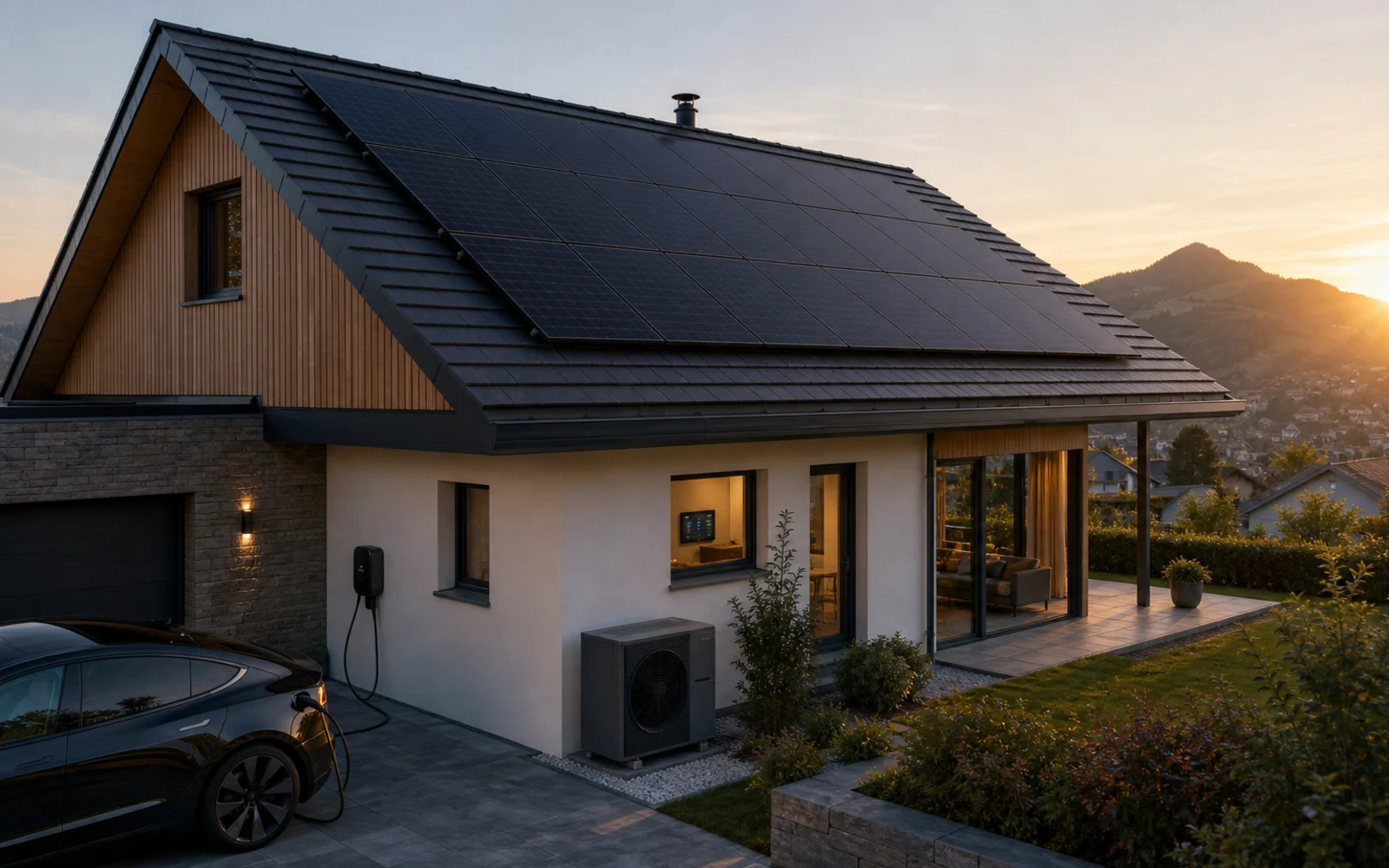
PV system, heat pump, storage, wallbox and monitoring from one team. Every service is planned as part of a working energy system.

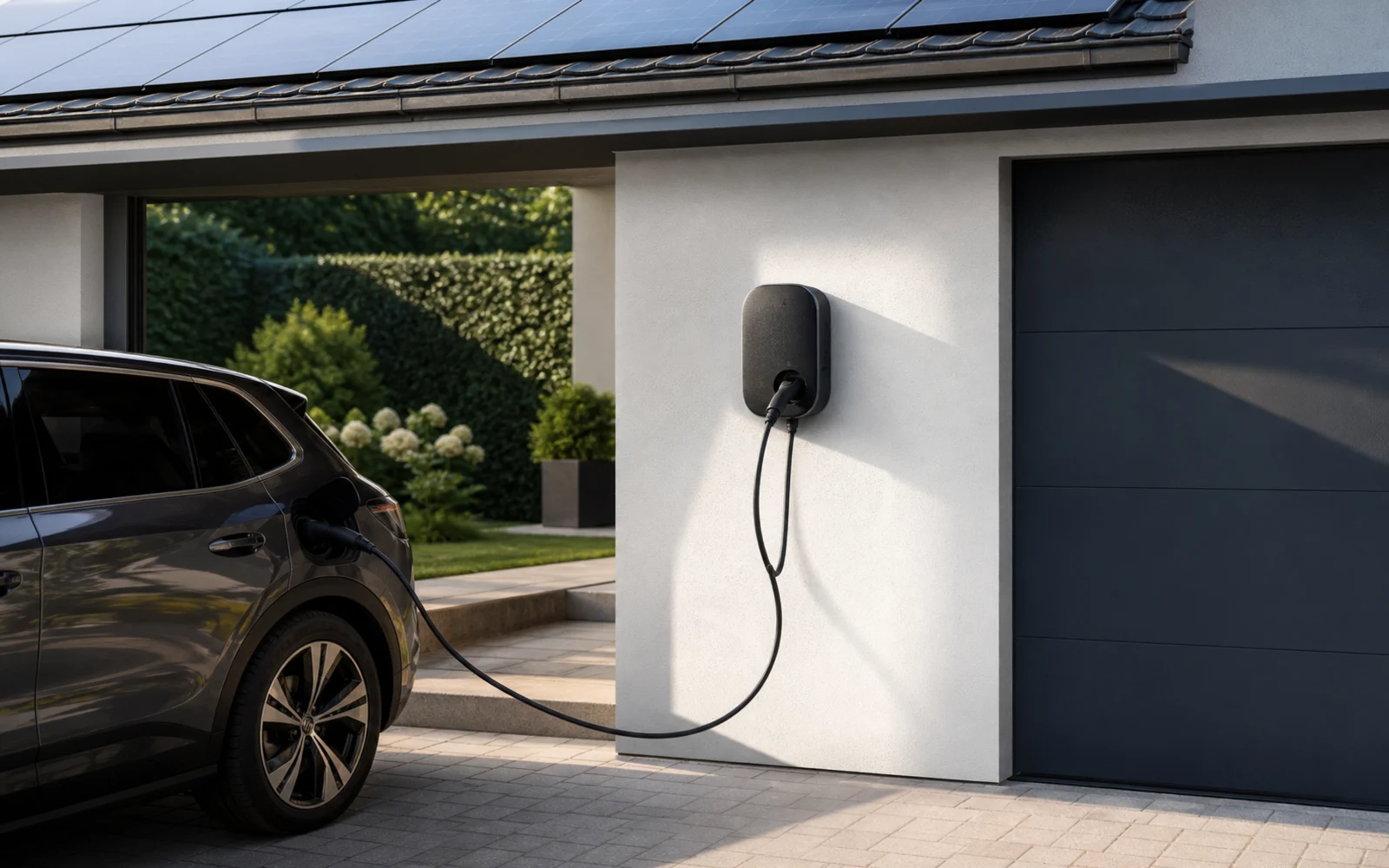
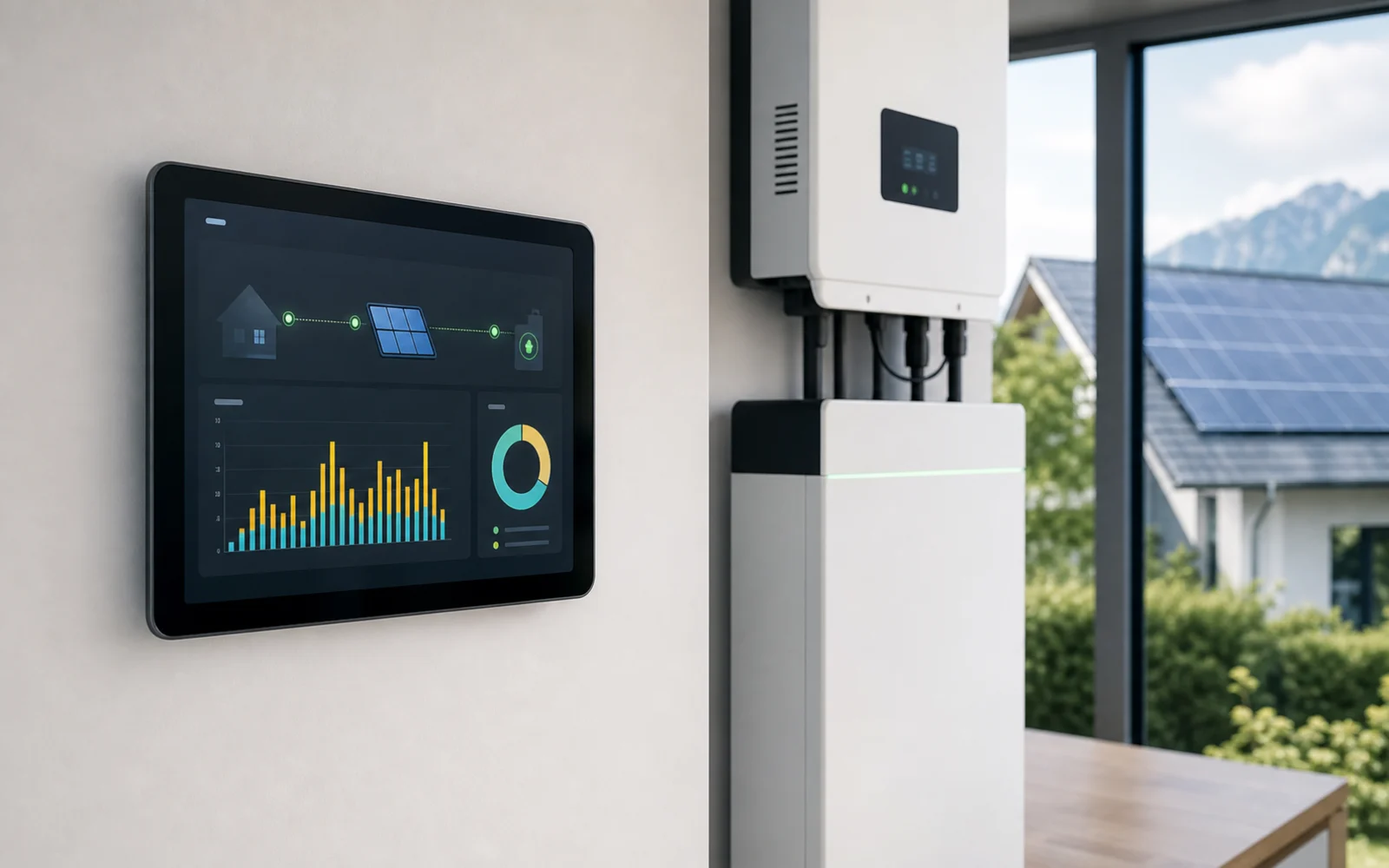
Illustration of a home with a solar roof, heat pump and charging station.

01 · Roof & facade

Plan and install PV systems cleanly.

We review roof, structure, shading, cable routing, inverter and grid connection. Then we create a technically reliable quote.

Roof review · Coordination of electrical work · Handover

01 / 05

Components by

  • Fronius
  • LONGi Solar
  • BYD
  • SolarEdge
  • Ernst Schweizer
  • SMA
  • Stäubli
  • Huawei
  • KOSTAL

Process

Understand first, then promise.

We clarify roof, electrical work, incentives and expansion path before you receive a quote. No site chaos, no wishful math.

  1. 01
    About 2 minutes

    Initial estimate

    Your key details are enough for a first, honest orientation. No appointment, no obligation.

  2. 02
    Response within 24 h on business days

    3D survey & technical review

    We measure the roof by drone and clarify electrical work, regulations and the grid operator.

  3. 03
    A few days after the survey

    Transparent quote

    You see every line item individually, realistic ranges and sensible options such as storage or a wallbox.

  4. 04
    After permit and grid-operator approval

    Planning, installation & handover

    Planning and installation by Vigorek. Electrical connection, grid registration and commissioning are handled by an electrical contractor licensed under the NIV. We coordinate schedules and documents.

From installation practice

What no one sees once the modules are on.

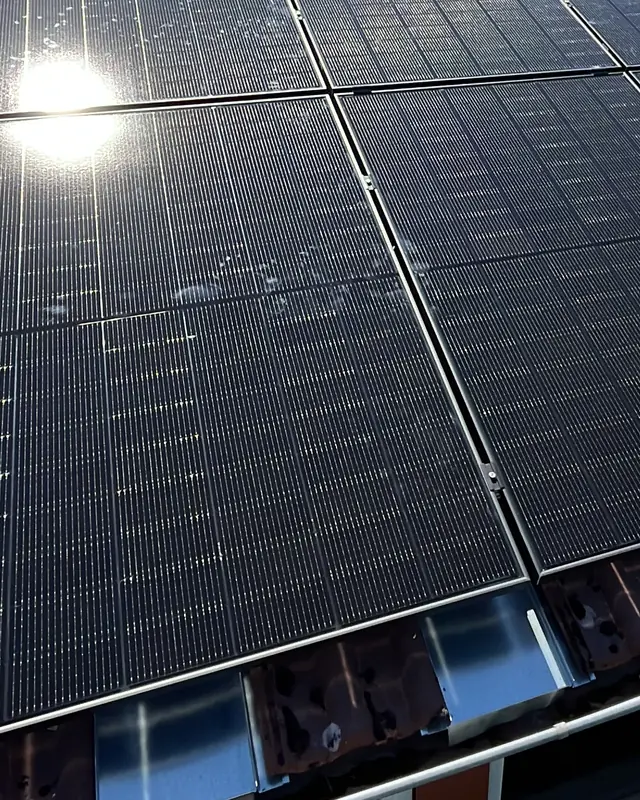
Hooks and rails disappear under the modules. That is exactly where it is decided whether a system holds and the roof stays watertight. Marc Hammerschmidt has installed roofs like these himself and recorded the work on his phone.

Original footage, day 1trimmed, no sound

Site diary · one tiled roof

  1. Hooks come first. They sit under the tiles and later carry rails, modules, wind and snow.

    • Every hook in line, so the rails sit without stress.
    • The tile above each hook lies flat again, so rain runs off as before.
    • The scaffold at the eaves is up before anyone steps onto the roof.
  2. Aluminium rails go onto the hooks. Where they end is decided in the plan, not on the roof.

    • Roof windows, vent pipe and chimney stay clear.
    • Rail rows run parallel, so the module field gets a straight edge.
  3. By day four, the field is in place. When hooks and rails are right, the joints run straight by themselves.

    • Even joints, clamps on one line.
    • The field ends above the eaves; the bottom row of tiles stays clear.

More roofs

  • Black modules on a red tiled roof on installation day, eaves and scaffold railing below
    Same roof · day 4The modules are in place. The joints run through every row.
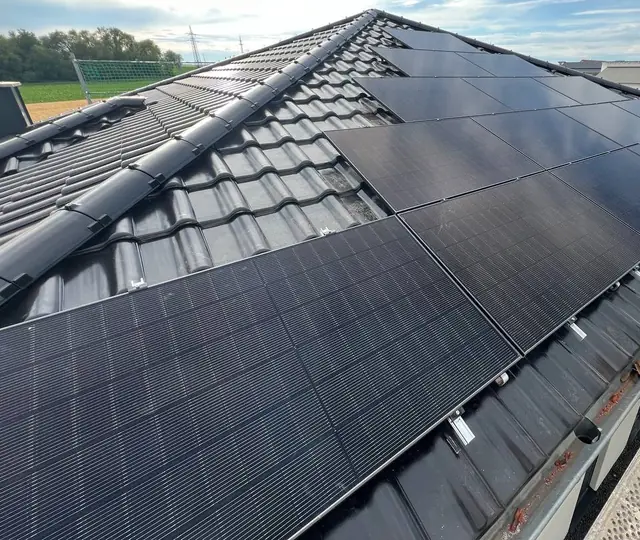
  • Hip roof with black tiles: the module rows get shorter towards the hip
    Hip roof · black tilesThe upper rows get shorter and follow the hip line.
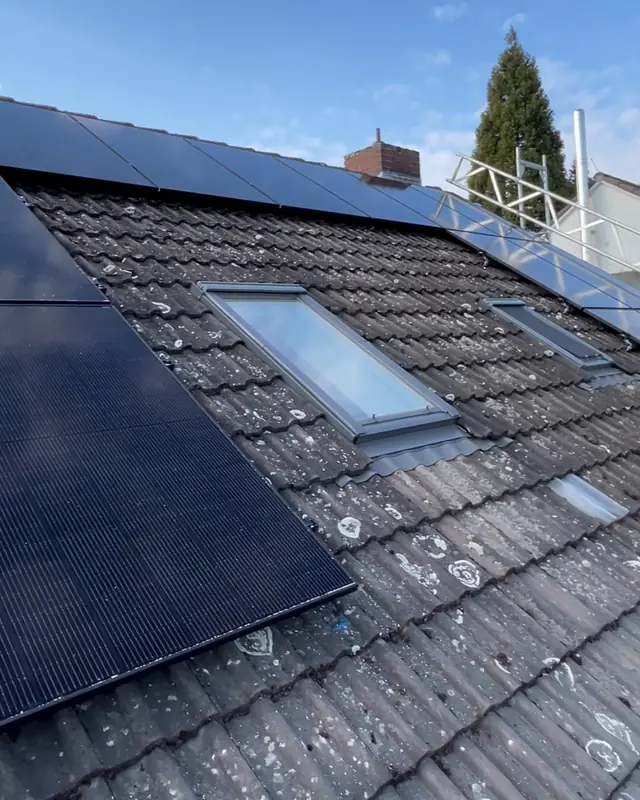
  • Black modules on a grey concrete tile roof, next to an uncovered roof window
    Concrete tile roofBlack modules with black frames; the roof window stays clear.

Where this footage comes from. Installations Marc Hammerschmidt worked on himself. To protect the owners, we do not name the location or the client.

Your installation. We document it the same way: every step with date and image, as part of your system records.

The Founders

Engineering depth. Financial structure.

You know before signing who calculates your project and who builds it: two founders, one for engineering, one for finance. A solar system only works long-term when both fit together from the start.

Christian Freiberger

CFA · former KPMG Senior Manager

Co-Founder · Strategy & Finance

Independent management consultant since 2015, previously Senior Manager at KPMG. Most recently Interim Treasury Manager at an energy storage manufacturer. Christian brings the financial structure: liquidity planning, transparent calculations and no project whose numbers don’t add up.

CFATreasuryBusiness case

Marc Hammerschmidt

B.Eng. Mechanical Engineering

Co-Founder · Engineering & Planning

Marc handles the technical side: planning, structural analysis and system integration. He has helped install systems on roofs himself and plans so that nothing has to be improvised on the roof.

Mechanical Eng.System planningStructural analysis

All municipalities

Solar in the 100 municipalities of the Canton of Graubünden

Registered systems, solar capacity per resident, energy price 2027 and winter share of roofs per municipality, from federal data. 21 municipalities have their own page (in German) with yield, build-out and listed buildings.

100 municipalities, alphabetical

Municipalities in the Canton of Graubünden with federal figures
MunicipalitySystemsW per residentct/kWh 2027
Albula/Alvra1041,53825.02
Andeer2464810.88
Arosa11664620.90
Avers786911.38
Bergün Filisur531,15427.88
Bever2255925.08
Bonaduz1901,13126.77
Bregaglia1045814.75
Breil/Brigels1581,90824.58
Brusio920710.60
Buseno445622.90
Calanca855123.90
Cama3577021.99
Castaneda321,32223.15
Cazis2111,88522.06
Celerina/Schlarigna1515625.90
Chur74666524.95
Churwalden1551,34124.81
Conters im Prättigau171,32923.58
Davos24056221.03
Disentis/Mustér1432,06724.58
Domat/Ems4091,01726.77
Domleschg2751,72422.06
Falera501,47424.58
Felsberg2091,64126.77
Ferrera1977.88
Fideris421,20525.08
Fläsch3498325.08
Flerden281,00722.06
Flims11687321.29
Furna1398225.08
Fürstenau2366322.06
Grono811,01421.30
Grüsch1532,16625.08
Ilanz/Glion3041,35424.58
Jenaz651,04825.08
Jenins451,06924.88
Klosters15974723.58
Küblis491,28023.58
La Punt-Chamues-ch1774925.28
Laax1031,04324.58
Landquart4041,89524.98
Lantsch/Lenz3087224.15
Lostallo581,39821.30
Lumnezia2081,79924.58
Luzein1401,62323.58
Madulain530325.28
Maienfeld1882,53023.80
Malans1171,09925.08
Masein641,30522.06
Medel (Lucmagn)301,62320.80
Mesocco7674919.16
Muntogna da Schons372,0678.38
Obersaxen Mundaun1161,75024.58
Pontresina5062623.58
Poschiavo1741,14617.50
Rhäzüns1271,07426.77
Rheinwald1981315.50
Rongellen007.88
Rossa639923.90
Rothenbrunnen301,53822.06
Roveredo11465922.15
S-chanf1992719.70
Safiental741,53819.15
Sagogn5797424.58
Samedan3740923.95
Samnaun914117.04
San Vittore472,60320.30
Santa Maria in Calanca968122.15
Scharans471,21628.80
Schiers11167825.08
Schluein562,29825.08
Schmitten131,07722.55
Scuol11351816.52
Seewis im Prättigau941,08525.08
Sils im Domleschg1626810.00
Sils im Engadin/Segl1286225.18
Silvaplana713825.18
Soazza1867221.30
St. Moritz4823725.35
Sufers91,62010.30
Sumvitg651,27024.58
Surses1241,17519.30
Tamins991,12026.77
Thusis4857914.50
Trimmis1131,39525.88
Trin9695721.29
Trun712,12424.58
Tschappina326,75322.06
Tujetsch921,58220.65
Untervaz821,46522.91
Urmein292,54222.06
Val Müstair711,85822.10
Vals1243915.05
Valsot352,74115.52
Vaz/Obervaz1951,62225.92
Zernez3240115.98
Zillis-Reischen177898.88
Zizers2022,09625.08
Zuoz2442125.08

Systems: SFOE register (as of 2026-09-14). Energy price: cheapest grid operator in the municipality excluding fixed and metering fees, ElCom, profile H4. Winter roof: October–March share of the roof solar potential, SFOE (sonnendach.ch).

Your next step: an initial estimate in about 2 minutes.

Your key details produce a first orientation on price range, incentives and payback. That is the basis on which we talk about your project.

Free and non-binding.Response within 24 h on business days.Your data stays with us.

Direct contact

If the project is already more concrete.

Roof plans, photos or an existing quote are easiest to send us by email or WhatsApp.

Location

Kirchweg 32, 8102 Oberengstringen, Zürich, CH

Coverage

Planning and installation of photovoltaics in the Zurich region, Limmat Valley and eastern Aargau. Electrical work by a partner with an installation licence.

WhatsApp

Open chat

Core services

Services with a real focus on Graubünden

The key services, tailored directly to Graubünden and the local requirements in your region.

All locations by canton and municipality

The locations directory gives you an overview of all cantons and municipalities and takes you straight to the information for your region.

Open locations